In January your Anlage V is already done.
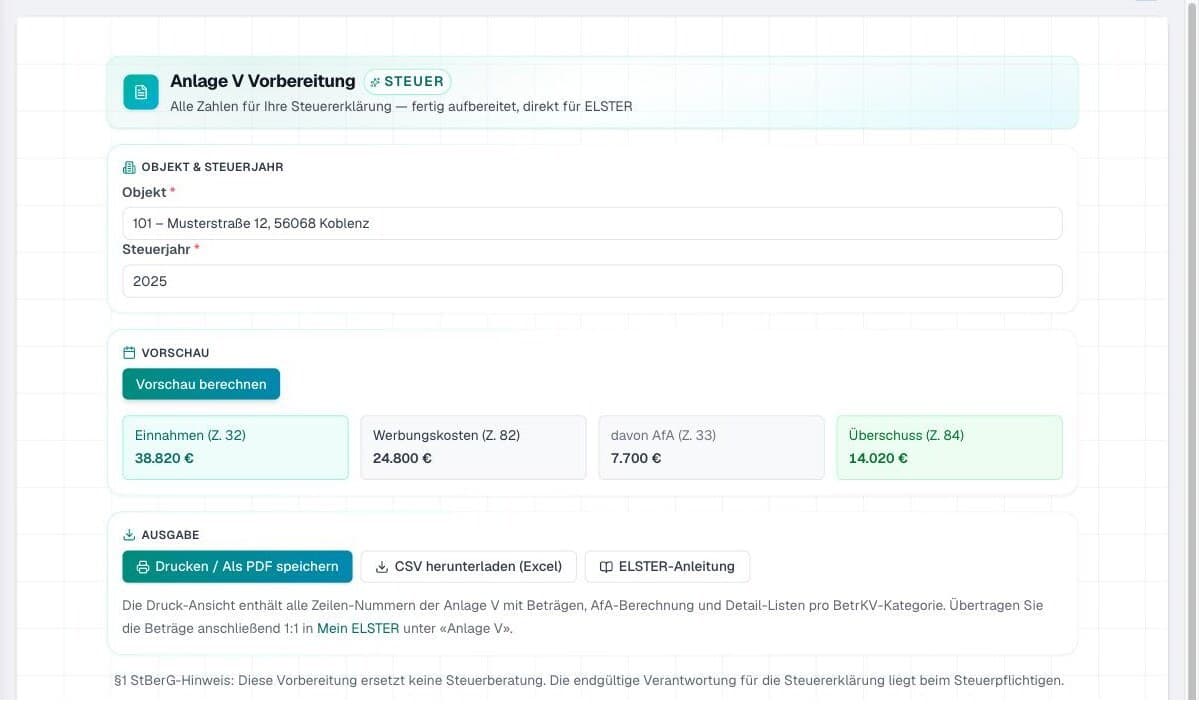
Every rent payment and every paid invoice of the year is already in its line — Savanika puts it there while you book it. In spring you transfer the report line by line into Mein ELSTER. No shoebox, no guesswork.
A document becomes a line
- Tradesman's invoice, paid in May
- Line 55 — fully deductible
- Loan instalment, every month
- Line 46 — the interest only
- Heating advance paid in December
- Next year — § 11 Abs. 2 S. 2 EStG
Three of the dozens of decisions in a year. Any spreadsheet can multiply — the deciding happens while booking. The line numbers follow the official Anlage V 2025 form.
Three steps you take anyway
- 01
Import the bank statement
MT940, CAMT or CSV. Every payment of the year lands on its SKR03 account — rent, insurance, tradespeople, interest.
- 02
Add the invoice
Amount, date and category are read from the document. The document stays attached to the entry — in case the tax office asks.
- 03
The line is already fixed
Every entry carries its Anlage V line with it. At year end: report on screen, printout, CSV for your tax adviser.
Your tax return is a by-product of the bookkeeping you keep anyway — not a second job in March.
What is not booked is not deducted. Account fees, postage, chimney sweep, winter service — the small amounts are the first to be lost when filling in by hand. Here no payment of the year is lost, and anything that fits no line appears as a notice with account and amount instead of quietly disappearing.
Start with last tax year.
You do not have to book for a year to see the result. Import last year's bank statements, add the invoices — and you have the Anlage V for a year you already know. Comparing it with your own figures is the most honest test we can offer.
A whole year of bank statements can be imported without any limit. The plan's document quota applies only to the AI reading of invoices — in the Start plan that is 20 a month. For a full year that means: either you spread the reading over two months, or we agree a one-off quota for the catch-up. Write to us and say roughly how many documents it is.
Last year's bank statements
MT940, CAMT or CSV from online banking — one import, no retyping.
Property and acquisition costs
Entered once: purchase price of the building, handover date, depreciation rate. Every following year is derived from it.
Look at the report
Income, deductible expenses, surplus — with line numbers and notices where data is still missing.
Line by line — and every figure comes from an entry
Income separated by type (lines 15, 18, 20, 26)
Flats, other premises, apportioned service charges, garages and parking spaces — kept apart, because the Anlage V asks for them separately.
Only what actually moved (§ 11 EStG)
Cash basis: an invoice counts in the year it was paid. Open items stay out. Exceptions apply to regularly recurring payments around the turn of the year and to the spread under § 82b EStDV.
Maintenance or improvement — decided per document
Whatever was modernised rather than repaired belongs in depreciation under § 6 Abs. 1 Nr. 1a EStG, not in line 55. The decision is made while booking, not in spring.
Spread over two to five years (§ 82b EStDV)
Larger maintenance expenses on residential buildings held as private assets may be spread. Savanika calculates the annual share and reports it in lines 57–60 — in every affected year, without a calendar reminder.
Apportionable (line 73), non-apportionable (line 76), loan interest (line 46)
Water, waste, insurance, lift on one side; management, bank, advice on the other. On a loan the interest counts — the repayment expressly does not.
Straight-line building depreciation (§ 7 Abs. 4 EStG)
Month-accurate in the year of acquisition under § 7 Abs. 1 S. 4 EStG, with residual value, final year and a formula you can check.
All line numbers on this page follow the official Anlage V 2025 form (as of September 2025). The form is reissued every year and the numbering shifts with it — for a different tax year, check the numbers against your own form. See the line-by-line guide
What most often goes wrong when filling in by hand
Repayment in line 46
Line 46 is for loan interest, not for the instalment. The repayment part is not a deductible expense.
Advance payment in the wrong year
What counts is the day of payment (§ 11 Abs. 2 EStG). For regularly recurring payments there is an exception: anyone transferring the January heating advance in the last days of December books it, following the case law, into the year it economically belongs to — the following year.
Acquisition-related cost booked as repair
Anyone investing more than 15 % of the building's acquisition cost — net, excluding land — within three years of the transfer of possession, benefits and burdens has production cost, not maintenance: to be depreciated instead of deducted.
Letting below market rent
From 66 % of the local rent upwards, the deduction of expenses is retained in full. Below 50 %, the letting must be split into a paid and an unpaid part (§ 21 Abs. 2 EStG). In between, the tax authorities take the view that a total-surplus forecast (Totalüberschussprognose) decides — if it turns out positive, the deduction stays full. Anyone letting to relatives should clarify this in advance.
What Savanika does not do
No submission to ELSTER
We send nothing to the tax office. You transfer the amounts into Mein ELSTER yourself — with our guide, line by line.
No tax advice
Savanika prepares figures and does not advise — the line is drawn by § 5 StBerG. In case of doubt the matter belongs with a tax adviser; a Lohnsteuerhilfeverein (income tax assistance association) may help with rental income only within the limits of § 4 Nr. 11 StBerG.
Straight-line depreciation only
Straight-line building depreciation under § 7 Abs. 4 EStG is implemented. Declining-balance and special depreciation are not.
In spring every owner calls
As a manager you already render account for income and expenditure — § 666 BGB. Savanika additionally puts those same figures into the shape your owner needs for the Anlage V: per property and tax year, to print or as CSV, with the documents attached.
The return is prepared by the owner or their tax adviser. You pass on figures and documents, not tax advice — the limit of § 5 StBerG applies to you as it does to us.
Anlage V with Savanika
Does Savanika replace the tax adviser?
No. Savanika prepares your figures — that is not unauthorised assistance in tax matters within the meaning of § 5 StBerG. What we take over is the groundwork: sorting, assigning, calculating, documenting.
Can Savanika send the Anlage V to ELSTER directly?
No, we have no submission interface. You enter the amounts in Mein ELSTER yourself — our guide shows for every line where it belongs.
I am just starting. Do I get the Anlage V for last year?
Yes, as soon as that year's bank statements and invoices are imported. The bank import takes MT940, CAMT and CSV and is not limited; only the AI reading of invoices is (Start plan: 20 a month). For a full year you spread the reading over two months — or we agree a one-off quota.
Which depreciation does Savanika calculate?
Straight-line building depreciation under § 7 Abs. 4 EStG, month-accurate in the year of acquisition. Declining-balance and special depreciation are not implemented.
What happens to a larger repair?
You deduct it fully in line 55 or spread it evenly over two to five years under § 82b EStDV — the provision sets no amount threshold. It applies to residential buildings held as private assets. You set the spread on the document; Savanika calculates the annual share.
Where do the amounts in the report come from?
From the payments of the tax year — cash basis under § 11 EStG. An invoice booked but not paid does not appear.
What if an entry fits no line?
Then it appears as a notice in the report, with account and amount. Nothing disappears quietly — before you file, you see where something is still open.
Preparing your Anlage V costs 90 € a year. Bookkeeping, service charge settlement and dunning are included in the same plan. See pricing
The next tax return is ready before you think about it.
14 days free, no credit card. Start with last tax year — then you see straight away what comes out at the end.